It goes in one end and out the other
March 2025. A poet wearing a black roll-neck with a bullfinch hanging from their ear walks into our launch event and stuns us with sexualised spiders and the aching loss of a family split across borders: whether that means Scotland, or the world after this one.
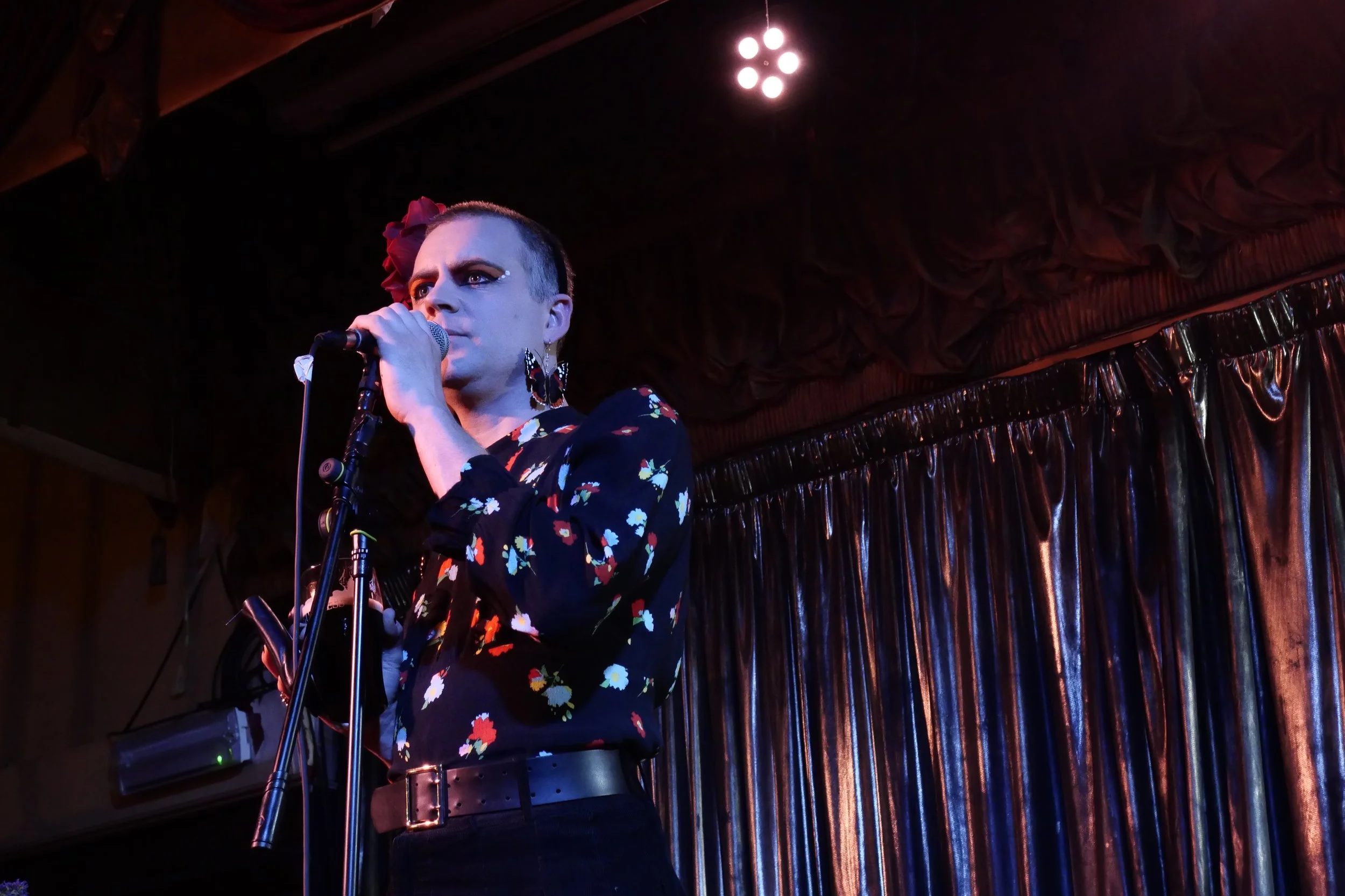
William headlining at their launch event. Ivy House, Peckham.
A few months later, William’s surrealism and sharp gaze is a core feature of Wild Thing collective. Now, to celebrate the launch of their debut pamphlet Butterfly Bush, published by Little Betty, we sit down in William’s Thameside studio, where they have been working for the past decade. Surrounded by the ephemera of the wandering craftsperson, Hebridean portals glint from the walls, alongside portraits of familiar faces from the London poetry scene.
Deep in the industrial docklands, and curled in a rolling chair, William weaves a tale that strikes me as faintly Sisyphean: lugging heavy boxes of reclaimed wood up mountains, turning out three paintings a day during expeditions, compelled by a thirst for output and a mortal fear of complacence. This culminated, as it often does, in crisis.
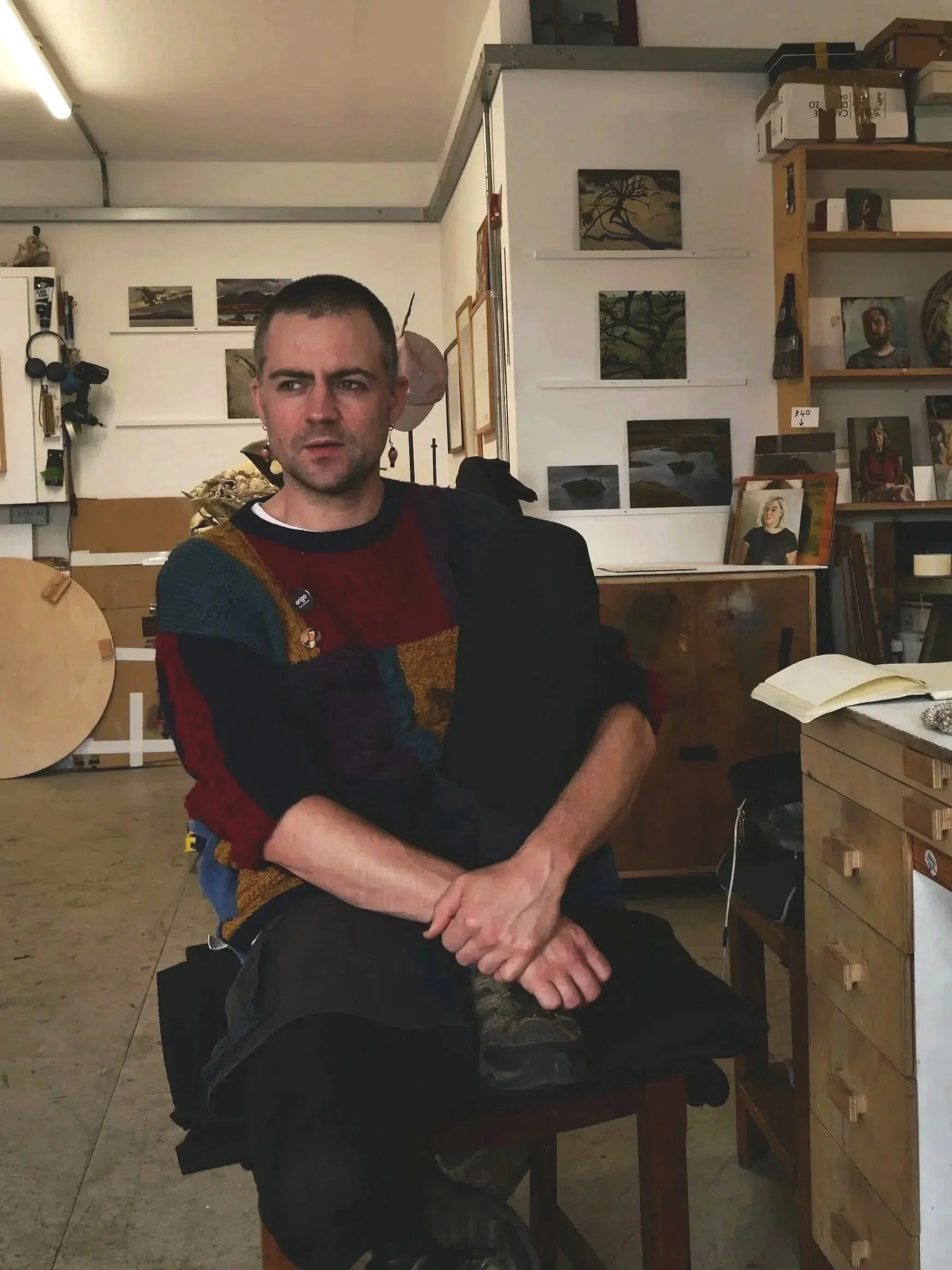
Deep in burnout and paired with a limiting injury, they were forced to stop. To learn how to move slowly and lightly through the landscape. Carrying little but a sketchbook and pencil around the inner Hebrides, William discovers how “it was as much about narrative as about making paintings”. Flicking through the sketchbook, a crab stands out, accompanied by a flowing script, from which arises the message, “rest in peace, proud warrior”. Walking on the beach with mum conjures the charge of air before a storm, the decomposing crabs, and the meticulous attention to detail that suffuses William’s work.
The furore of the natural world and its density of interlocking processes is their first stop, their font of inspiration: “constantly evolving and changing…dying and decomposing… germination and flowering or pupating…fighting itself, hunting, feeding or mating”. William’s own practice reflects this continuous movement, chasing the “nirvana” of being engaged physically with a problem, finding a solution through the poetic process.
The opposite of this generative friction, i.e. our very human habit of making systems that make things more efficient, leaves a bad taste in William’s mouth. In our relentless pursuit of comfort, “we’re running out of problems to solve, and yet there’s one huge problem left that we’re not solving”. The flood of Black Leopard, and the drought of the eponymous Butterfly Bush, facing off on opposite leaves are the pamphlet’s doomspell nod to the crisis we find ourselves in, like waking up from a nightmare with blood on your hands.
“One of the things that makes humans unique is that we can look at our own behaviour…and choose something else”
Yet, like the deer on the Isle of Arran, with no natural predators, we have scalped the landscape of cover. The difference being that the deer has no choice but to eat.
*
William’s work flourishes in the inverse of this surgically scoured emptiness. Interested in difference, they relate to anything that is in a constant state of change and renewal, finding this fundamental to how they inhabit the nonbinary experience of gender. Brought out explicitly in Growing up or What we think about Tintoretto, reflecting William’s dualistic nature that overlays construction site carpentry with “going out in dresses”; and more covertly in poems that break the human-species barrier, such as Spiders, and What have you come as, where we are invited to think beyond human embodiment, into the arthropod - arachnid or crustacean.
“If we constrict the ways it’s possible to be, we stagnate creatively and emotionally…if you create a monoculture in nature, it stagnates”.
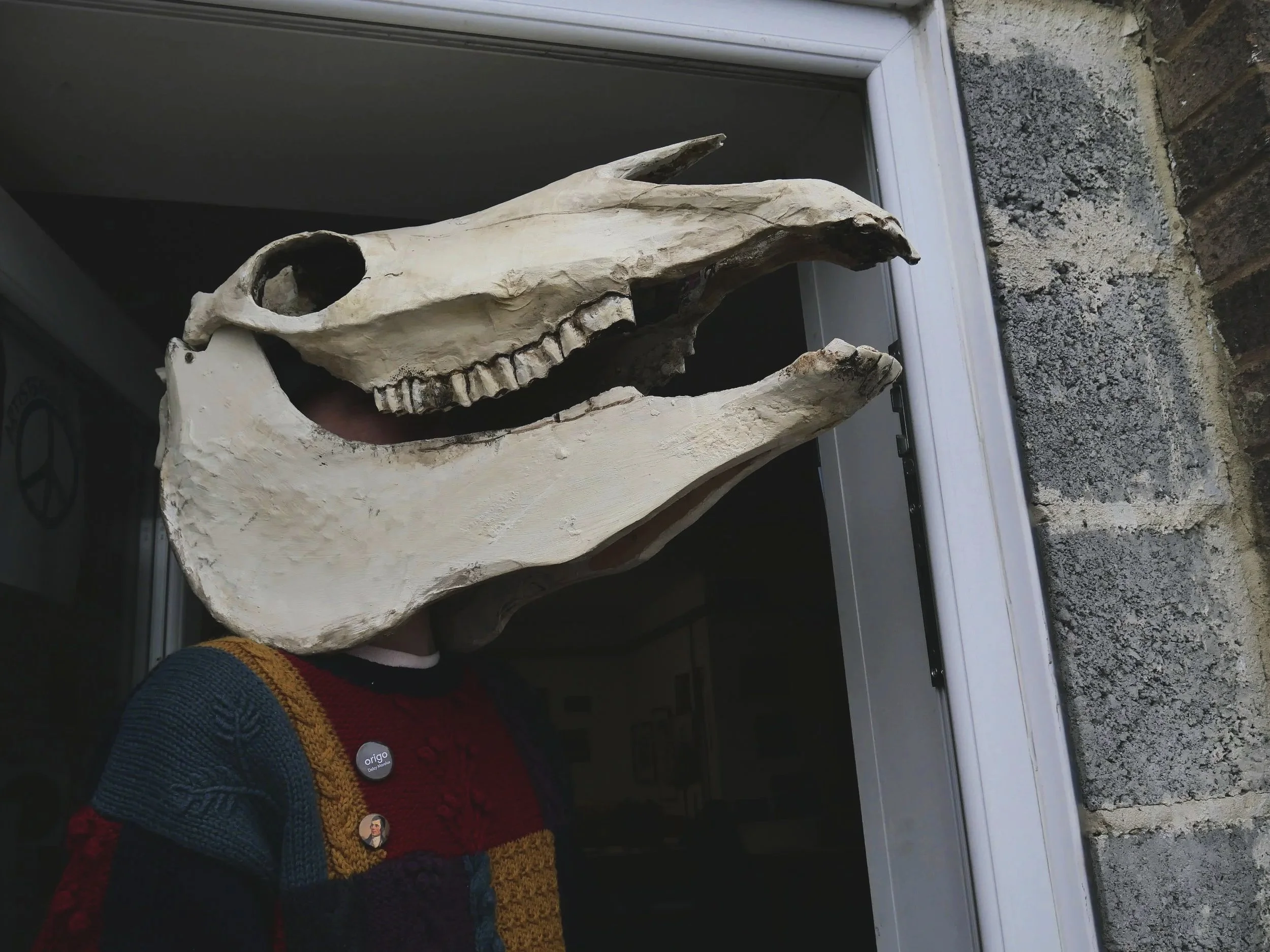
William’s own Mari Lywd. Thameside Studios, Woolwich.
We play around with the oversized masks on the side table. I find myself face to face with a baby’s head on a man’s body, an anachronistic Mari Lwyd, the original horse skull grinning benignly from the top shelf. This psychedelia triggers my fear of the abject in the same way as key absurdist poems, such as Run, where William transmutes the everyday, separating their subject from their legs, to communicate “the strangeness and brutality of existing in a body” in ways that verisimilitude cannot.
*
Following a decade of pace, Butterfly Bush is a different kind of craft. A craft that reflects the slowing down catalysed by injury and chronic pain, more evocative of their roots in meticulous still life manifestations, rather than the quickfire practice of their second artistic phase. Reflecting on the process of refinement, William speaks of the necessity of putting poetry out into the real world, lifting it from the page. Gauging how it feels rolling off your tongue, whether it’s “still fun to read” 20 performances later. Whether it strikes a desirable chord in your audience’s gut. Where the artist’s perceptive talents meet the deeply analytical instincts of the poet. What they’re chasing? An acolyte of subversion, William knows their work is close when the audience is silent: not knowing what to think, how to react, or whether they are even finished.
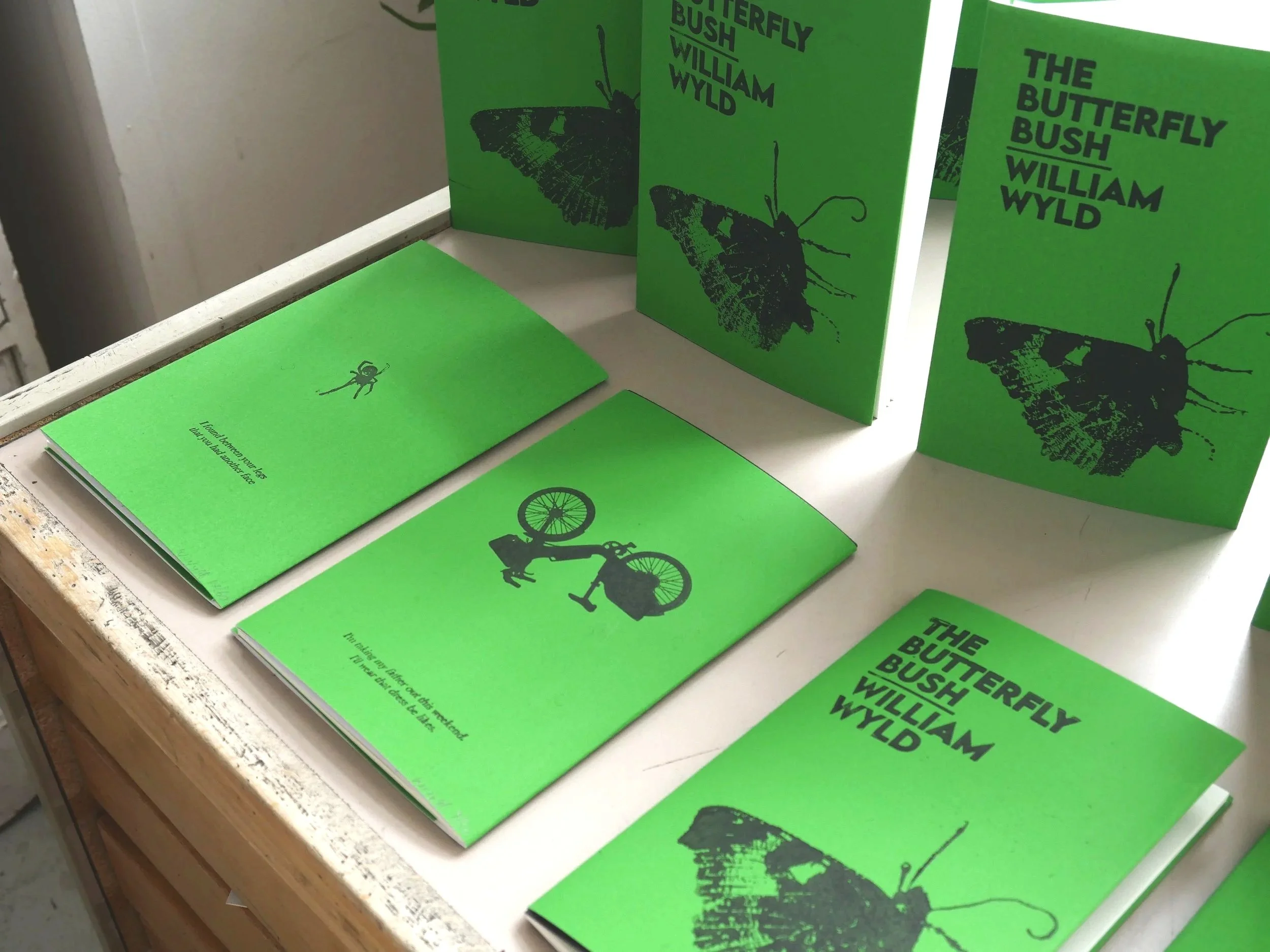
Special edition pamphlets, with hand-printed covers.
Published by Little Betty press.
We speak about Katherine, their late mother who inhabits the pamphlet from dedication to end-leaf. Asked about the courage and complexity of transforming grief into creative output, William’s response evokes the very tension held in the pamphlet’s final piece The poems are the most important thing, right?
“Fundamentally, I just want to write good poems…because you can write really badly about grief”
In their pursuit of quality and psychic weight, delivered with hallucinogenic surreality, William masters the balancing act between wit and anguish, between play and candor, demonstrating phenomenal range, from
You were so sweet
And kind, Mum, but your corpse is a fucking nightmare.
to
The world reacts as if I am carrying on, so I carry
on. I shake the hose and water glitters in effortless silver
arcs. It goes in one end and out the other.
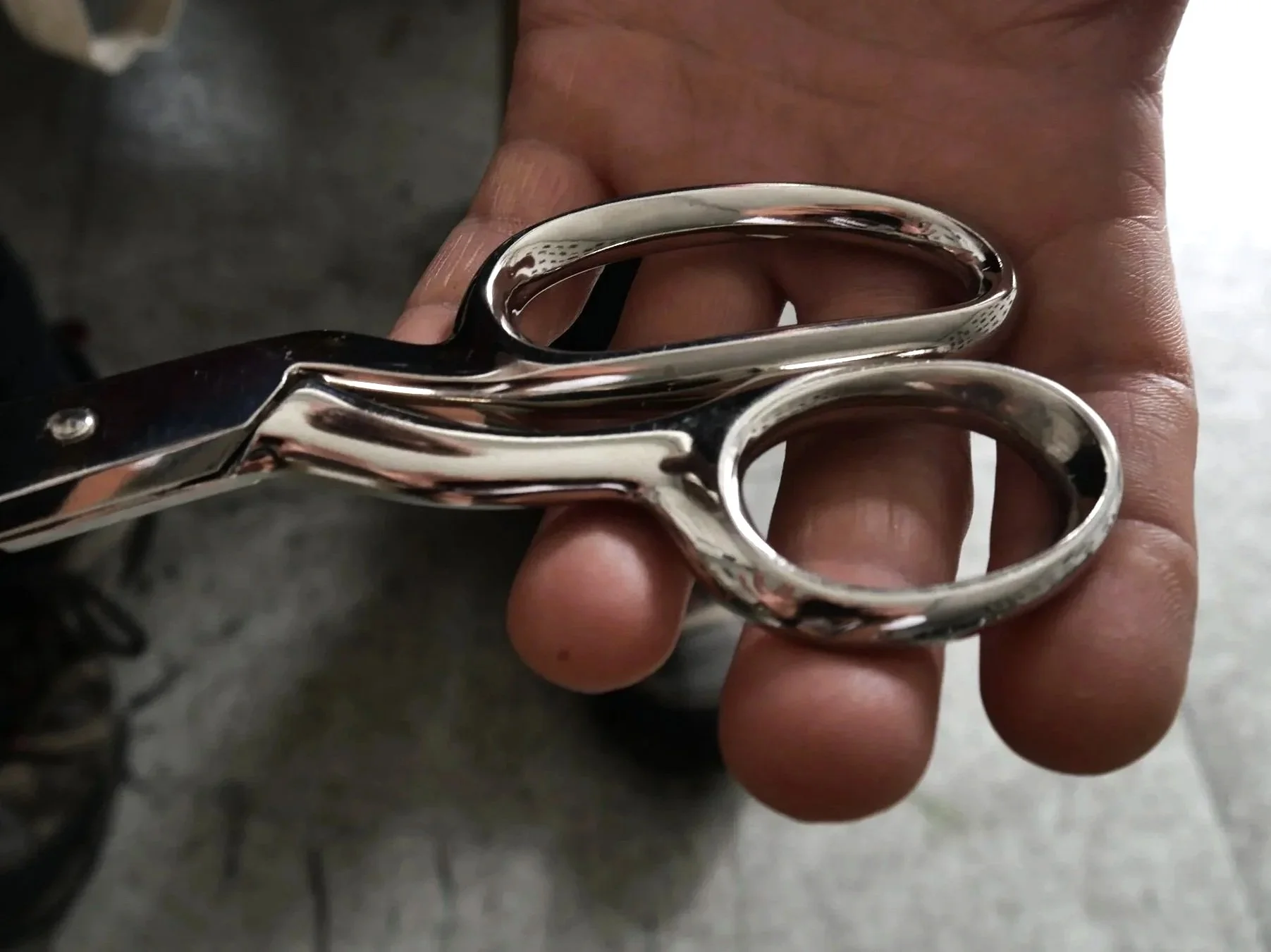
Katherine Wyld’s dress-making scissors.
What next?
After a year of crafting the pamphlet (which you can buy here from Little Betty, or hear in the real world on William’s Butterfly Bush tour), William knows they will start painting again. Holding out Katherine’s dress-making scissors balanced in the palms of both hands: “I love the silveriness of them, the way they’re made up of infinite little reflections of the real world.
Interview and photography by Tara Brown, @rubynayantara on instagram and LinkedIn.